

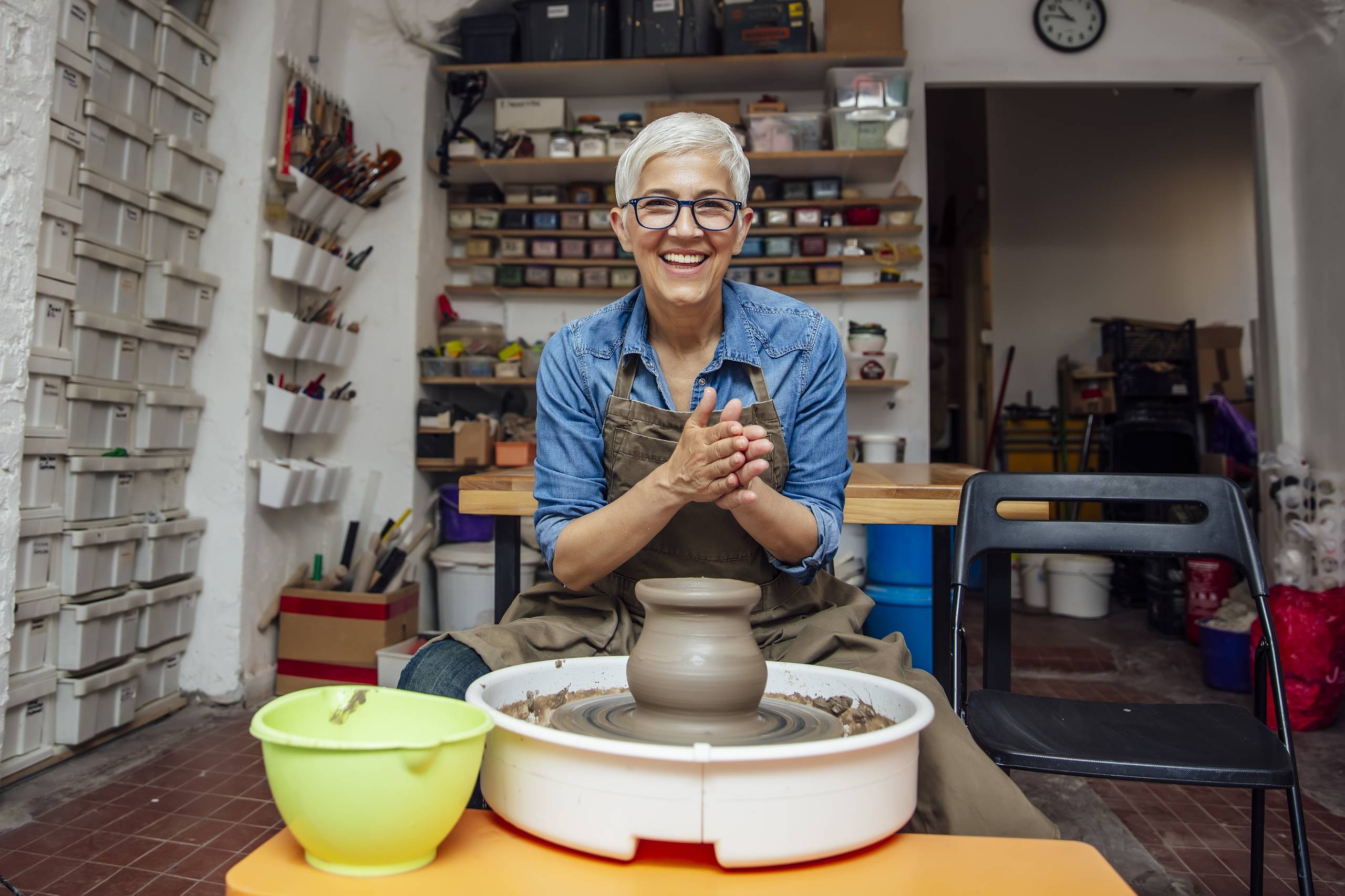
Clay reacts directly to the amount of pressure applied, the speed of movement and any moments of hesitation. It’s an honest material that will always reflect the condition of both the hands that touch it and the mind that guides them. It’s no surprise then, that the practice of ceramics has been a longtime tradition, not just as a means to a creative end, but as a discipline to foster patience and mental clarity. Every time at the potter’s wheel or table is a conversation of intent and response, and there’s no way to force the clay to do something it doesn’t want to do without suffering the consequences.
One of the first clay lessons is respect for the process. Hurrying through the centering process, neglecting to prepare or not paying attention to moisture content usually results in weak and problematic forms that will later show their shortcomings by collapsing, cracking or deforming during the firing process. As you work repetitively, you come to realize that your progress is the sum of small gains. A better posture here, a lighter touch there, a bit more time on this gesture and a bit less on that one. The consistency of these improvements eventually adds up to a sense of stability and control in your work, rather than a reliance on happenstance and luck.
The physical demands of ceramics also aid in cultivating a greater sense of awareness. Your hands develop a sensitivity to the subtle nuances of resistance in the clay and your body learns to adjust its positioning to maintain balance and control. This is knowledge that can’t be gained by simply reading diagrams and looking at pictures. It must be built through the act of doing and by paying attention to the physical feedback your body receives through the process. And through the process, confidence develops not from the avoidance of mistakes, but from learning to recognize them early and being able to respond to them with grace and ease.
In addition to the technical benefits of practicing ceramics, it also has a way of fostering a certain mindset. You learn to accept that not every piece is going to be successful and that the real value lies not just in the end result, but in the actual process of making. This mindset helps to dissipate any attachment to the expectation of a specific outcome and, instead, places emphasis on your progress and understanding. Many people have found that this way of thinking has transferred to other areas of their lives and has helped them approach their problems with a greater sense of patience and perseverance.
At its core, working with clay is less about mastering the creation of an object and more about developing a relationship with a material. With every cycle of creating, drying and firing, you’re reminded that the rewards of patience and respect for the natural boundaries of a material far outweigh the instant gratification of expedience and force. In a society that prizes efficiency and speed, ceramic work offers an alternative tempo, one that values depth, care and intent and quietly instills those same qualities in the people who engage in it.